For Maggie, on her 80th
Through 30 years of marriage to Molly, every visit with you and Ken was an adventure. My God, the joys we shared, the troubles we confronted and the blessings we earned! From that first meeting when you picked us up in Glenwood Springs for the drive to Paonia, I felt acceptance and kinship. You were at the wheel of some beater and passed a joint to me in the backseat. I'll admit I felt a rush of relief when we made it into the valley after watching you round the curves on those mountain gravel roads with vertigo-inducing vistas. Six months later, we joined you and Ken in San Francisco and Sonoma, where your folks were then living. The highlight of that trip: walking into City Lights Bookstore, like a rube, browsing the shelves for a half hour and telling a staffer, "Hey, this is a pretty good bookstore." I assume it was Ken who gently pointed out to me its historic importance to American letters.
And then there were all the trips that followed. A night in Bonanza, a soak in Hemez hot springs, the Earth First! festival, our year in Crestone, driving those Mexican kids back to Tuscon, a visit with Elaine in New Mexico. I could go on. In my memory, every encounter with you was such an intense family and cultural experience.
But the births were by far the highlights. Juniper's arrival last week reminded me of how much you helped us adjust to the shock of becoming parents. Your month-long stays with us for the births of Jasper and Claire were the greatest gifts you ever gave us. You calmed our fears, helped us through the endless labour that led to Jasper's birth and you kept that wild boy amused while we rushed off to the hospital for Claire's arrival.
And that was just the beginning. I admire how by being present at their births, you laid the solid foundation for enduring relationships with each of your grandchildren. Now that Molly and I have our own grandchildren, I see her following in your footsteps. John is as utterly devoted to her as our kids are to you. I hope, too, that I can be to John and Junie what you were to Jazz and Claire. You set a fine example for all of us.
So, I wish you the very best on this milestone birthday wherever you might be sojourning. As I write this, Claire is winging her way toward you. She brings hugs and love from all of us up here.
Rick
Sunday, March 26, 2017


Saturday, March 25, 2017
Community Development Thinking: Window into Tara in Grad School
This doesn't hold a candle to Rick's beautiful poem about Juniper, and is a bit dry, but is what my life is full of these days ...
The body is good to
think with, or, what a reading of Coates can offer community development
thinkers
“You must always
remember that the sociology, the history, the economics, the graphs, the charts,
the regressions all land, with great violence, upon the body.”
- Ta-Nehisi Coates, Between the World and Me
Ta-Nehisi
Coates’ bestselling book Between the
World and Me is typically read as a framework for understanding the history,
racism, and experience of being black in America. It does offer brilliant
insight into all of this. It also offers something more novel: a new language
and analytical framework for community development. Coates’ notion of the body
(specifically the black body) as the primary site upon which history has been
written and resistance performed, is a tool for more deeply and fruitfully
engaging with the foundational concerns of community development theory and
practice.
Community
development is something of an unwieldy term that can be defined in a myriad of
ways. Offering one partial definition, historian Alice O’Connor (2012)
describes community development as a “time-honored tradition in America’s
response to poverty” (p. 11). A deeper theoretical interrogation is provided by
the political scientist Jnanabrata Bhattacharyya who suggests that community
development is a response to the erosion of agency and community solidarity, or
shared identity and norms. Bhattacharyya (2004) writes that the ultimate goal
of such work should be to promote “human autonomy or agency – the capacity of
people to order their world, the capacity to create, reproduce, change, and
live according to their own meaning systems, to have the powers to define
themselves as opposed to being defined by others” (p. 12). Taken together,
these definitions indicate that the praxis of community development should
involve efforts aimed at both understanding poverty and increasing community
capacity through (re)building the power of individuals.
This
conceptualization does not only identify the focus of community development. It
points to the need for incorporating the individual as a unit of analysis. “Community”
cannot be interrogated and addressed without engaging the building blocks of
that community: individuals. So, how do we conceive of the individual from a
community development perspective?
This is where we return to Coates’ notion of the body. In his
formulation the body is where history – and specifically those developments
that have generated poverty and violence – is embodied and continually
manifest. For Coates, violence perpetuated by black men and women is a response
to the anxieties inherent to their own physical vulnerabilities as black bodies
in a racist world whose riches have been built on their own backs. Poverty and
violence in poor minority communities are consequences of laws and policies
that have deliberately attempted to make bodies “breakable.” Black bodies have
been the target of the very policies and actions that have engendered the kinds
of inequities community development so often attempts to address. Addressing
his son Coates (2015) writes,
“The process of
washing the disparate tribes white, the elevation of the belief in being white,
was not achieved through wine tasting and ice cream socials, but rather through
the pillaging of life, liberty, labor, and land; through the flaying of backs;
the chaining of limbs; the strangling of dissidents; the destruction of
families; the rape of mothers; the sale of children; and various other acts
meant, first and foremost, to deny you and me the right to secure and govern
our own bodies” (p. 8).
The visceral quality of Coates’ language of the body is
important. Effective community development initiatives cannot only be grounded
in an analytical understanding of what poverty is and how it has been created.
They must be informed by a knowing of poverty, a sense of what it means
experientially. If poverty and inequity are the primary problems of community
development, the body is good to think with. It sheds light on how conditions
of poverty have come to be, and the texture of their consequences.
Thinking of the
individual through the framework of the body also allows us to engage the
ultimate purpose of community development work: agency. Again, since
community-level capacity rests on the self-actualization of individuals, the
individual must be considered alongside community. The agency of individuals is
in part built and manifest in the body. In conditions of inequity and poverty
it is often built through healing. It is manifest as resistance. Commenting on
the audacity and swagger of urban youth Coates (2015) remarks, “they were
masters of their own lives, their own streets, and their own bodies” (p. 15).
Physical presentation and presence, ways of inhabiting the black body, are methods
of resisting impoverishment and other forms of racialized oppression. There is
agency in resistance and thus the potential for agency to be accessed and
exercised through the body.
Coates does not directly
engage the body as a site of healing, which is anther critical means of
promoting agency or, as Bhattacharyya writes, peoples’ ability to define
themselves. This is where community development thinkers have an opportunity to
build on the foundational framework Coates has established. Thinking through
the body as a site for (re)building power through healing allows us to
conceptualize radical interventions that defy the limitations of conventional
initiatives as part of the community development tradition. It is a framework
for thinking about why community development matters, what it is, and what it
could be.
My next post will
explore that potential. For now, I’ll leave you with one last chilling
quotation from Coates (2015) that makes the relevance and utility of his
language for the capital-obsessed community development thinker undeniable:
“Black life is cheap, but in America black bodies are a natural resource of
incomparable value” (p. 132).
Sunday, March 19, 2017
A Poem for Juniper Wilde by her grandpa, Rick Boychuk

A poem for the arrival of first granddaughter.
by Rick Boychuk
JUNIPER in MARCH
Comes now a child of winter
Daughter of the cold, a berry beginner
A boreal baby, grounded in Gatineau granite
An infant whose smile will light up the planet
A new star for the family constellation
A little sister, to John River’s elation
Blessed with a diverse genetic inheritance
A rich co-mingling, according to the available evidence
We are certain of indigenous American, Colombian, Irish, German and Ukrainian
And suspect sprinklings of Spanish, Greek, Italian and Scandinavian
There’s more, too, obtained through marital acquisition
Step-grand- and great-grandparents ushered in via family re-formation
This girl will have no shortage of instructing adults
Her challenge will be deciding whom to consult
First, though, will be making a space for herself in the house
Amidst cat, dog, brother, parents and occasional mouse
The landscape of her childhood, Cantley’s valleys and hills
To roam and explore in hothouse heat and sub-arctic chills
She’ll learn from Mom’s clever craftwork
And Dad’s gardening and creative woodwork
Brother John will have to adapt and adjust
And learn to share every hug and crust
Raise a glass to this familial shift
Juniper’s arrival a well-timed gift
Comes now a child of winter
Daughter of the cold, a berry beginner
A boreal baby, grounded in Gatineau granite
An infant whose smile will light up the planet
A new star for the family constellation
A little sister, to John River’s elation
Blessed with a diverse genetic inheritance
A rich co-mingling, according to the available evidence
We are certain of indigenous American, Colombian, Irish, German and Ukrainian
And suspect sprinklings of Spanish, Greek, Italian and Scandinavian
There’s more, too, obtained through marital acquisition
Step-grand- and great-grandparents ushered in via family re-formation
This girl will have no shortage of instructing adults
Her challenge will be deciding whom to consult
First, though, will be making a space for herself in the house
Amidst cat, dog, brother, parents and occasional mouse
The landscape of her childhood, Cantley’s valleys and hills
To roam and explore in hothouse heat and sub-arctic chills
She’ll learn from Mom’s clever craftwork
And Dad’s gardening and creative woodwork
Brother John will have to adapt and adjust
And learn to share every hug and crust
Raise a glass to this familial shift
Juniper’s arrival a well-timed gift
Juniper Wilde Boychuk
Born: 3:24 pm, March 18
8 lbs, 4.8 oz
Parents: Jennifer Castro and Jasper Boychuk
Born: 3:24 pm, March 18
8 lbs, 4.8 oz
Parents: Jennifer Castro and Jasper Boychuk
Monday, February 20, 2017

Wednesday, February 15, 2017
Pilgrimage
It was Tara's idea to walk the camino in the first place. I couldn't help but add a second part to include horses and the rocky mountains. Anybody wish to join part or all of this adventure?
"Please join me in congratulating Master of Architecture student Darby Prendergast for winning the Schoeman Traveling Fellowship for Architecture. Darby’s proposal involved taking two pilgrimages — one from Lisbon Portugal to Santiago de Compostela, Spain; and the second one from Crawford, Colorado to Chimayo, New Mexico.
"Please join me in congratulating Master of Architecture student Darby Prendergast for winning the Schoeman Traveling Fellowship for Architecture. Darby’s proposal involved taking two pilgrimages — one from Lisbon Portugal to Santiago de Compostela, Spain; and the second one from Crawford, Colorado to Chimayo, New Mexico.
The review committee consisted of Geraldine Forbes Isais, Dean of the school, and Karen King, Associate Director of Architecture."
Proposal: Schoeman Travel
Fellowship
Darby Prendergast, M.Arch/MLA
Statement
of Intent
Architecture
can be understood as the act of making place through imagining and shaping
space. I am proposing to explore this notion through completing two pilgrimages:
the Camino de Santiago, which crosses the Iberian Peninsula, and across the
Rocky Mountains from Western Colorado to Chimayo, New Mexico. As an aspiring
architect, I believe that understanding place is foundational to meaningful
design. I also know where I intend to be a designer: the Rocky Mountain
West. Completing the established pilgrimage of the
Camino de Santiago and then embarking on a journey across the Rocky Mountains
will help me develop a lens through which to gain a deeper understanding of
place; it will inform my future as an architect.
For more
than 1,000 years the “Camino” has been a pilgrimage that starts in multiple
points across Europe and ends at the cathedral of Saint James in Santiago de
Compostela, Spain. I will walk the Portuguese route, which starts in Lisbon and
runs north along the coast of Portugal. This route crosses ancient Roman roads
and bridges and passes by several UNESCO world heritage sites as well as 12th
century monasteries. I have never been to Europe and know that it is a rich
architectural landscape that is important for me to explore as I evolve as a
designer. The pilgrimage offers a rich
study. The pace and perspective of moving on foot enables heightened
observation and a sensory experience of place.
The Camino
will establish a framework for the second part of my journey, which involves
applying honed observational skills to the study of my own place. Here I will ride
a horse from my family ranch in Crawford, Colorado to Chimayo, New Mexico. This
route is the same distance as the Camino (350 miles) and also ends in a
centuries old point of pilgrimage. It will take me through some of the wildest
and most well-protected areas of pristine wilderness in the world. Wilderness
is the treasure of the Rocky Mountains. Passing through these wild places will
give me the opportunity to contemplate how architecture can be informed by and
honor the heart of this landscape.
Research
Methodology
These
pilgrimages are fundamentally about developing moral sensibilities and
observational skills. My research is a comparative analysis of landscape. I
expect to find significant differences between each pilgrimage; the juxtaposition
will inspire creativity and reflection. My research methodology involves traveling
slowly and recording the sensory experience of place. I will use the Grinnel
Journal method for recording my observations. This method provides a template
for collecting objective field notes and sketches throughout each day and then compiling
them into a formal layout each evening. In addition to keeping a detailed
journal, I will also bring a Canon EOS Rebel DSLR for photography and a Garmin
eTrex 20x GPS for way finding. I will thus be able to present compelling
photographs, drawings, journal entries and maps.
Itinerary
Camino de
Santiago: June, 2017
Lisbon,
Portugal à Santiago de Compostela, Spain (see
map for route)
Distance: 350 Miles/12 miles per day = 30 days
Highlight Sites: projects by Alvaro Siza in Lisbon
and Porto, Quinta da Cardiga historic manor house, historic city of Tomar, University
of Coimbra (UNESCO World Heritage Site), ancient roman road Via Romana XVI,
Matriz de São Miguel Church, historic city of Porto (UNESCO World Heritage
Site), 12th century Mosteiro de Leca do Balio Monastery, Dom Zameiro
bridge, Chapel of Santa de Franqueira, historic town and 12th
century cathedral of Tui, Chapel of Santiaguiño de Antas, bridge of Sampaio, 13th
century chapel of Santa Maria, historic city of Pontevedra, castle of A Rocha
Vella, Santiago de Compostela (UNESCO World Heritage Site)
Chimayo: July,
2017
Crawford,
Colorado à Chimayo, New Mexico (see map for
route)
Distance: 350 miles/16 miles per day = 22
days
Highlight Sites: West Elk Wilderness, Powderhorn
Wilderness, La Garita Wilderness, Weminuche Wilderness, South San Juan
Wilderness, Chimayo
Budget
Camino de
Santiago:
Airfare-
$1,200
Lodging- $15/night x 30 nights
= $450
Food- $15/day x 30 days = $450
Equipment-
$400
Train/Bus (return to Lisbon) =
$100
Total = $2,600
Chimayo:
I own the horses and necessary equipment required for this trip.
Food- $20/day x 20 days = $400
Horseshoes- $75/horse x 2
horses = $150
Tack Maintenance = $150
Trailer (return to Crawford)-
$1/mile/horse = $350 x 2 horses = $750
Total = $1,450
Grand
Total= $4,050
Tuesday, January 31, 2017
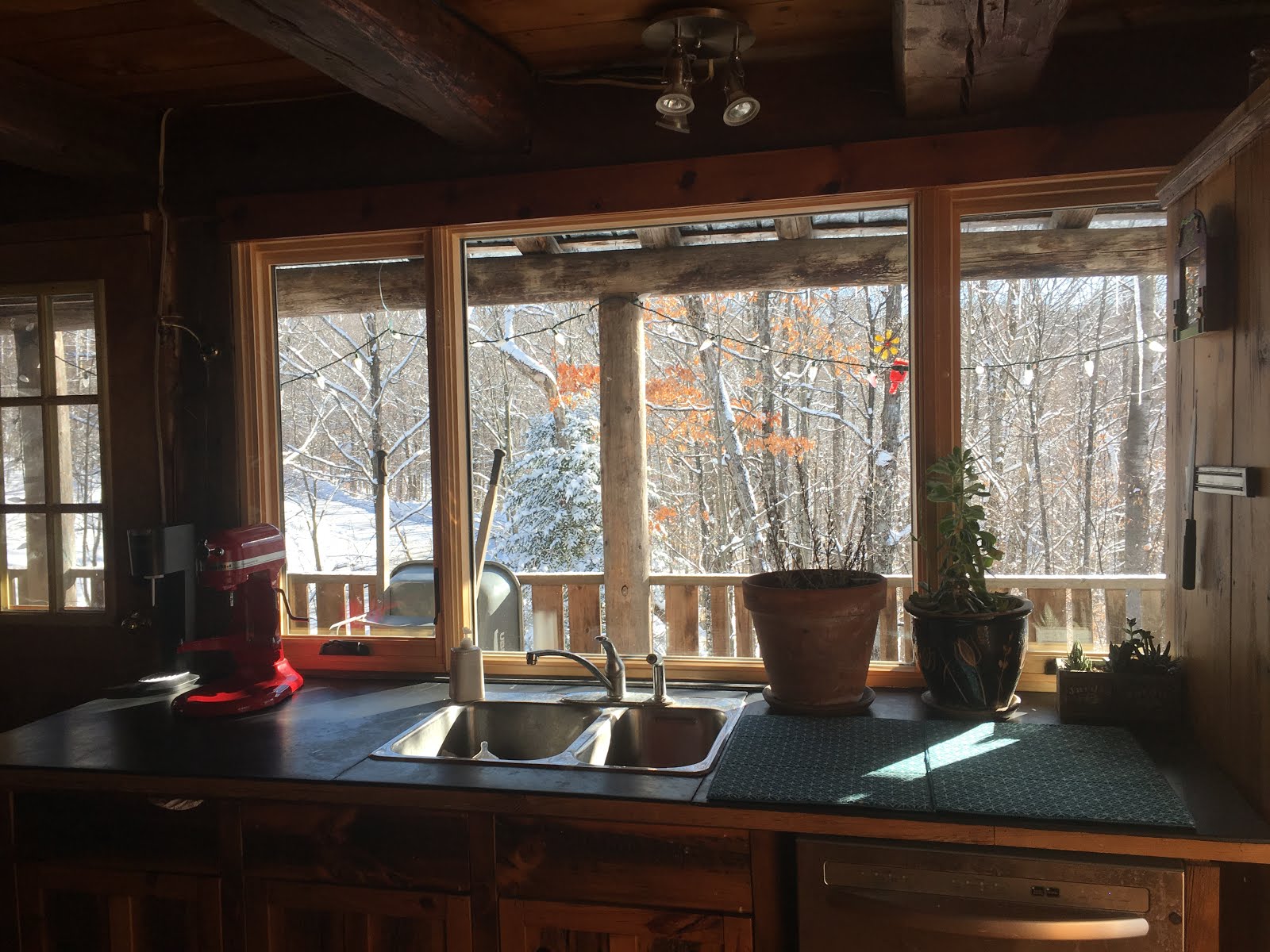
After much belabored deliberation and a long wait for fabrication, the much needed new windows for the living room arrived in a January thaw, a lovely weekend of low negative single digit temperatures. Final decision was to go with a local Quebec manufacturer, Martin, aluminum clad clear select ponderosa pine with double glazed argon filled assemblies. With help from the godfathers, Calvin and Joe, and good old Rick, we managed to get them all hung on one long Saturday. Worked by myself Sunday from 8 am to 2 am insulating, trimming and applying finish, with the deadline of getting Jenny and John home as soon as possible. Took Monday off and spent the day airing out the varnish fumes and cleaning up the havoc, enhancing some openings with a chainsaw and cutting back the counter tops to accept the deeper window had kicked up a lot of dust. All said and done, put in in 42 hours over the weekend, lost 2 lbs and made a dramatic impact on the quality of our home, all just in time for temps to drop back down to -25 C, the norm of this time of year. I need a couple of weeks to recover before I do the doors, which will need a good varnishing before install. Pics to follow their installation.




Subscribe to:
Posts (Atom)